When You Are the Signal
Caregiver exhaustion is not a failure. It is information families need to read before a crisis forces the decision.
There is a moment I have seen on the faces of more caregivers than I can count.
It usually comes late, in a hallway or a waiting room, after something has finally forced the issue. It is the look of a person realizing they have been running on empty for a very long time, and only now, when they can finally stop, do they feel how tired they are.
If you are caring for someone you love, you probably already know the signals the guidance tells you to watch for.
The falls. The missed medications. The weight loss. The confusion.
Nearly everything written about knowing when it is time keeps its eyes on the person receiving care. That is the right place to start. But after thirty-four years in long-term care, in direct service as a social worker and admissions director and later on the technology side of the industry, I have come to believe there is one more signal, and it is the one most families read last, if they read it at all.
It is you.
The caregiver’s own condition is an important indicator that a care arrangement may be reaching its limit. And it is the hardest signal to see, because the person it is happening to is the same person who has decided, quietly and without ever saying it out loud, that their exhaustion does not count.
I think of a husband I will call Frank, a composite of many spouses I sat with over the years. His wife’s memory had been slipping for a long time. He covered for her at dinner, took over the driving, then the cooking, then the medications and the bills. He stopped sleeping through the night. He lost weight. When his grown children visited, he told them everything was fine, and they wanted to believe him.
What none of them could see, Frank least of all, was that he had become the thing that was about to break.
When I finally met him, what he said was not about his wife.
It was, “I don’t know how to stop taking care of her myself. I don’t know what that makes me.”
Here is what it made him.
Tired. Human. And overdue for help.
Not a failure.
If you recognize yourself in any of what follows, I am not asking you to make a decision today. I am asking you to notice, the way you have learned to notice everything about the person in your care, and to turn a little of that attention back on yourself.
Your sleep went first, and you barely remember when
Sleep is usually the earliest thing a caregiver surrenders, and because it goes gradually, most people cannot say when it happened.
You are up for a bathroom trip, a noise, a wandering, a worry. Broken sleep, night after night, is not a personality trait or a phase. It is a physical condition with real consequences, and it wears down the patience and judgment the work requires.
Your own health has slipped, and you have stopped tracking it
The appointment you keep rescheduling. The prescription you have not refilled. The symptom you would take seriously in anyone else.
Caregivers routinely let their own medical care lapse, not because they do not know better, but because there is no room left in the day. When the person keeping everyone else going stops tending to their own health, that is not devotion.
It is a warning.
Your world has narrowed to one person
The friends you no longer call. The invitations you decline before you finish reading them. The parts of your life that used to be yours and have quietly closed.
Isolation can make a caregiver’s strain harder to recognize and address, because there may be no one close enough to reflect back what they see.
You feel resentment, and then you feel ashamed of it
This is the signal caregivers will admit to last, if ever.
Resentment is not evidence that you are a bad spouse or child. It is what happens when a person gives more than they have for longer than anyone could sustain.
The guilt that follows it is proof of how much you care.
Both feelings are telling you the same true thing.
You have realized you could not handle an emergency alone
A fall you could not lift them from. A moment of agitation you could not calm. A medical event where you understood, in your body, that you were the only one there and it was not enough.
That realization is one of the clearest signs that a solo arrangement has passed what one person can safely carry.
Why this signal is so hard to read
We miss it because naming our own exhaustion feels like a complaint, and complaining feels like not loving them enough.
So we file it away.
But your exhaustion is not weakness, and it is not a character flaw. It is data.
And it is data about two people, not one, because a care arrangement that is slowly dismantling the caregiver is, by definition, not a sustainable arrangement for the person receiving care either.
Your limits are part of their picture.
What to do when you see it
Noticing is not the same as placement, and placement is not the only thing on the other side of noticing.
Between doing it all alone and moving someone to a facility, there is real middle ground: in-home help for a few hours a week, an adult day program, a respite stay that gives you a genuine break and gives your loved one a preview of what more support can feel like.
The point of reading your own signals early is the same as reading anyone’s early signals.
It buys you choices.
It lets you act while there is still room to plan, instead of in the aftermath of the night that finally forces it.
Start by saying it out loud to one person who is safe to say it to. A sibling. A friend. A doctor. The care team where your loved one is seen.
The signal loses some of its weight the moment it stops being a secret you are keeping from yourself.
Taking care of yourself is not separate from taking care of the person you love.
It is part of the same responsibility.
A care plan that depends on your exhaustion is not really a plan. It is a warning. And the earlier you name that warning, the more choices you still have.
Meet The Author – Cory Fosco

Cory Fosco has spent thirty-four years in long-term care, in direct service through social work and admissions and later on the technology side.
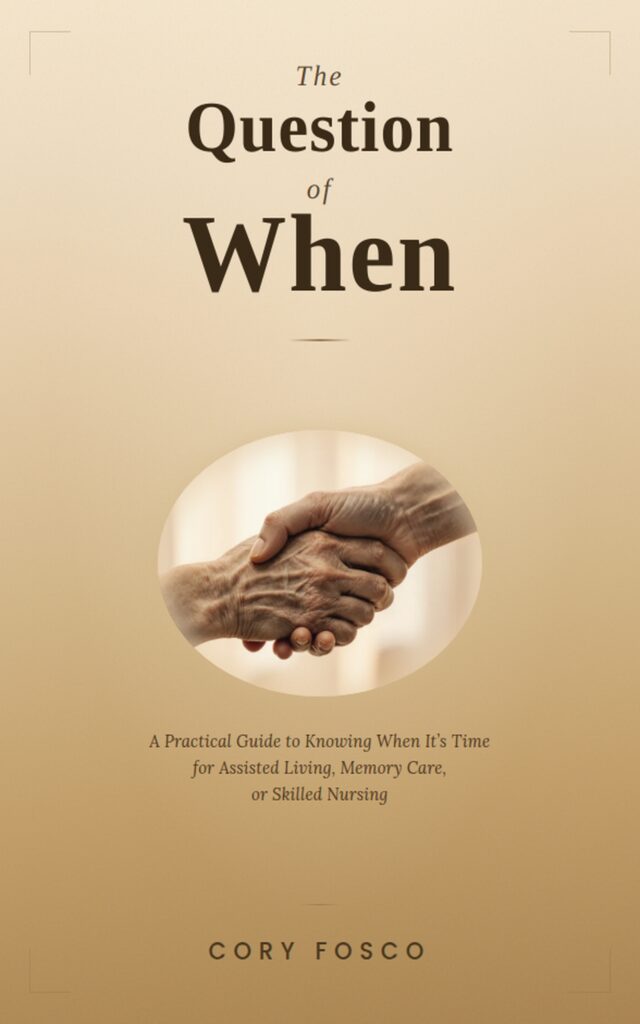
He is the author of The Question of When: A Practical Guide to Knowing When It’s Time for Assisted Living, Memory Care, or Skilled Nursing (Campion Hall Press). He lives and works in the Chicago area. More at https://coryfosco.com.